
1. Material Science in Coating: Different Requirements for Wood, Metal, and Plastics
The physics of coating adhesion varies drastically across substrates. A “one-size-fits-all” approach often leads to delamination or surface defects.
Wood: The Living Substrate
Wood is hygroscopic and anisotropic. When liquid coatings are applied, the wood fibers absorb solvent, causing “grain raise.”
Requirement
- : Use of sealers with high solids content to lock fibers.
Challenge
- : Managing the volatile organic compounds (VOCs) while maintaining the natural texture.
Metal: Conductivity and Corrosion
Metals require precise surface energy management. Industrial components often face harsh chemical environments.
Requirement
- : Chemical pretreatment (phosphating or chromating) to ensure a molecular bond.
Strategy
- : Electrostatic spraying is preferred for complex geometries like valves to ensure “wrap-around” coverage.
Plastics: Heat Sensitivity and Static
Plastics often have low surface energy, making them “non-polar” and difficult for paint to wet.
Requirement
- : Flame or plasma treatment to increase surface polarity.
Caution
- : Curing temperatures must remain below the plastic’s glass transition temperature (Tg) to prevent warping.
2. Humidity & Temperature: Preventing Defects During Curing
The curing phase is where chemical cross-linking occurs. Environmental fluctuations here are the root cause of 80% of coating failures.
Preventing Wood Cracking
If the booth humidity is too low, wood releases moisture rapidly, leading to structural cracks or “checking.” Conversely, high humidity slows down solvent evaporation, causing “blushing” (trapped moisture turning the film white).
Engineering Solution
- : Yingma’s integrated humidification systems maintain an Equilibrium Moisture Content (EMC) of 6-8%, ensuring the wood remains stable during the flash-off period.
Avoiding Metal Oxidation
For industrial metal components, high humidity during the pre-heat or flash-off stage can cause “flash rust.”
Critical Control
- : The substrate temperature must always be at least 3°C above the dew point. Automated HVAC controls in modern booths track these sensors in real-time to adjust airflow temperature.
3. Versatile Booth Design: Adapting Airflow for Diverse Scales
A furniture manufacturer may need to coat a delicate chair in the morning and a massive industrial cabinet in the afternoon. Airflow dynamics must be adaptable.
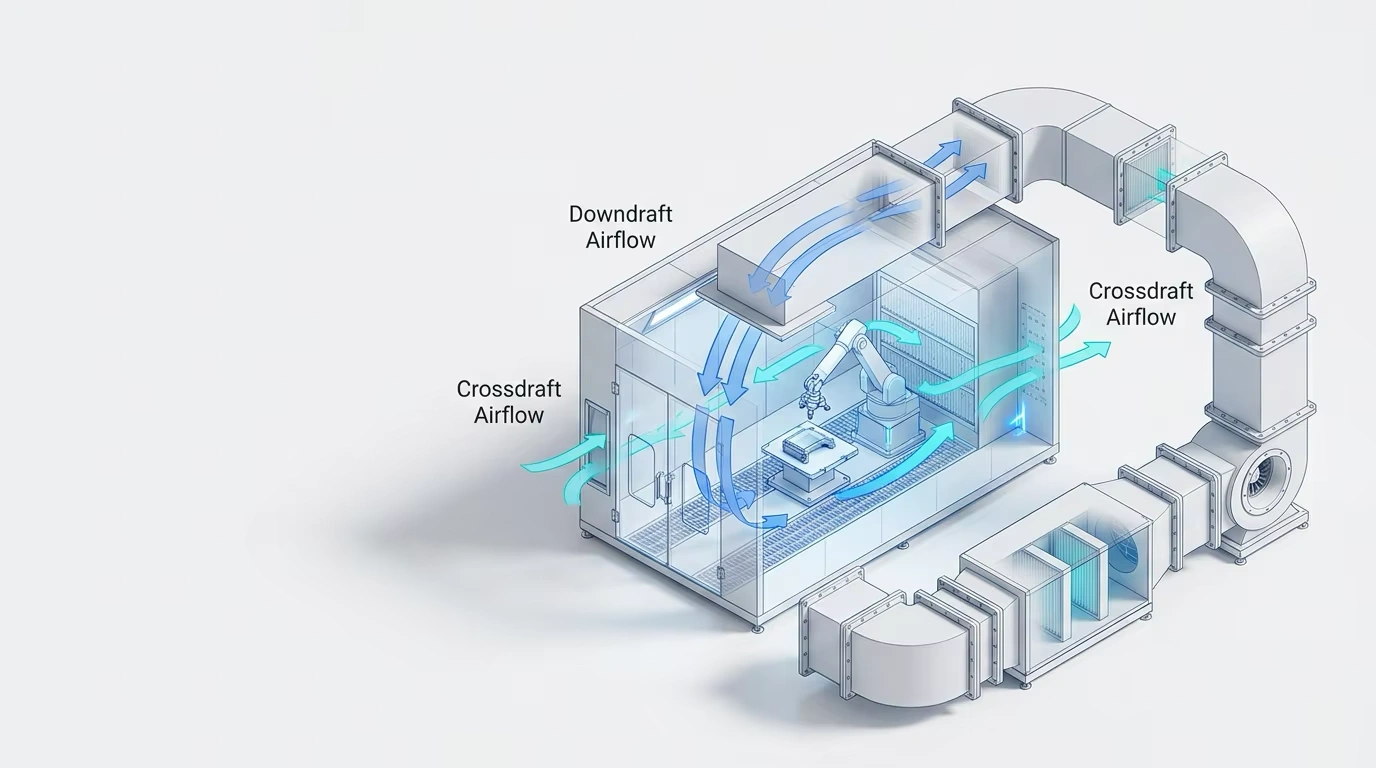
Downdraft vs. Crossdraft
- Downdraft: Best for high-end furniture and automotive parts. Air moves vertically, pulling overspray directly into floor filters, minimizing the chance of dust settling on the horizontal surfaces.
- Crossdraft: More economical for long industrial components where the operator needs to move around the object.
Variable Frequency Drives (VFD)
Modern booths utilize VFDs to adjust the volume of air based on the product size. Coating a small valve doesn’t require the same CFM (Cubic Feet per Minute) as a wardrobe. This adaptability reduces energy consumption and filter wear.
4. Automation Integration: The Rise of Robotic Painting Lines
Industry 4.0 has transformed the coating room from a manual craft to a precision data-driven process.
Robotic Precision
Robotic arms provide consistency that human operators cannot match, specifically in the “overlap” percentage of spray strokes.
Data Sync
- : Yingma’s automation interfaces allow the booth’s ventilation to sync with the robot’s activity. When the gun is off, the airflow can drop to a “standby” mode, saving up to 40% in operational costs.
Vision Systems
Integrating AI-driven cameras allows the line to identify the geometry of the incoming part and automatically select the correct coating program. This “mix-and-match” capability is essential for versatile production lines.
5. Quality Control: Achieving Mirror-Like Finishes
For high-end furniture, a “Class A” finish (mirror-like) is the benchmark. This requires absolute control over contaminants.
Multi-Stage Filtration
The air entering the booth must be filtered down to 5-10 microns. Using high-efficiency ceiling filters ensures that no airborne particles mar the wet film.
The “Cleanroom” Protocol
Quality control starts before the paint hits the surface. Air showers for operators and anti-static flooring prevent the introduction of lint and dust into the coating environment.
6. Conclusion & CTA
Engineering versatility into your production line is no longer an option—it is a necessity for growth. By understanding the material science of your substrates and controlling your environment with precision equipment, you can achieve world-class finishes on every product.
At Shandong Yingma Machinery Equipment Co., Ltd., we specialize in designing the future of coating technology. From custom-built spray booths to fully automated industrial lines, our engineering team is ready to help you master the art and science of finishing.